

Editor’s note: Originally published in 2021. Updated for today’s strategic, leadership and market context.
How a Strong Value Proposition Differentiates Your Business and Drives Growth : Why Leadership Clarity Strengthens Commercial Meaning
A strong value proposition is not only a marketing message. It is a leadership decision about meaning, relevance and commercial clarity. When leadership teams lose focus, allow priorities to multiply or fail to define what the organisation most wants to be known for, the value proposition usually weakens long before the market can name why.
That matters because customers do not experience a value proposition as an internal strategy document. They experience it through what the organisation consistently makes clear, credible and commercially meaningful. When that consistency weakens, sales effort increases, pricing power softens and the brand starts to feel less distinct—risking even becoming generic.
This is one of the clearest bridges between Brand Leadership and Leadership Friction. Brand Leadership helps explain how organisations create market meaning externally. Leadership Friction helps explain why that clarity begins to weaken internally when judgement, ownership and coherence are no longer strong enough to hold it in place.
A value proposition is a deceptively simple but critically important part of every brand’s success because it communicates why your brand is attractive to your primary target audience and what makes it different to your competitors.
It explains in distilled terms the value your brand delivers, which is effectively the primary reason for a customer to choose to do business with you. If your brand proposition is weak or hasn’t yet been fully developed then now is the time to re-evaluate it fast because a strong value proposition is a concrete business tool that drives your brand’s sales and profits.
Here we’re sharing with you six reasons why a strong brand proposition matters together with commercial application examples explaining how, so you can achieve stronger performance from both a brand, leadership and profitability perspective.
Leadership Reality
Leadership teams often believe they have a value proposition problem when they actually have a coherence problem: too many priorities, too many offers, and not enough clarity about what the organisation is really trying to mean in the market.
1. All Effective Brand Communication is Built on a Compelling Value Proposition
A value proposition is your unique, compelling offering which differentiates you from your competitors. It sets you apart, so you stand out to attract your ideal potential buyers. In fact, it’s a central part of your brand strategy because it makes what you’re selling, product or service, more compelling to your target audience, and so increases customer attraction and conversion rates to grow your sales.
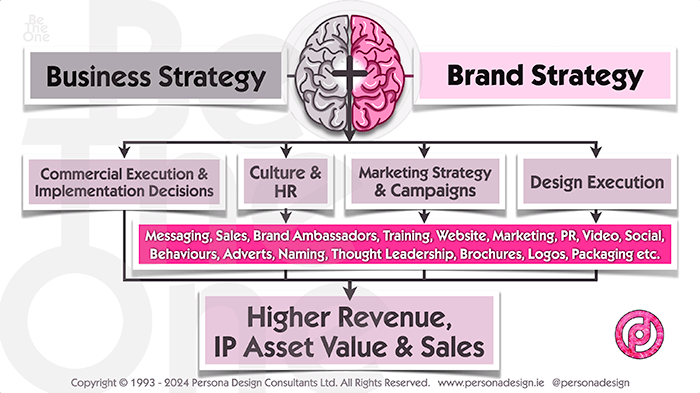
It is possible to have a brand strategy or brand communication without a value proposition. Indeed, a lot of brands do focus on the “how” of brand communication without having first got clarity on the “what” or “why” of what they are communicating.
However, a brand without a clearly conceived value proposition typically underperforms and never realises its true potential or commercial value. A strong value proposition helps you sharpen your focus because it’s integral to your brand strategy and consequently, all your brand communications. That makes it more effective and also more painless because it enables you to avoid costly mistakes.
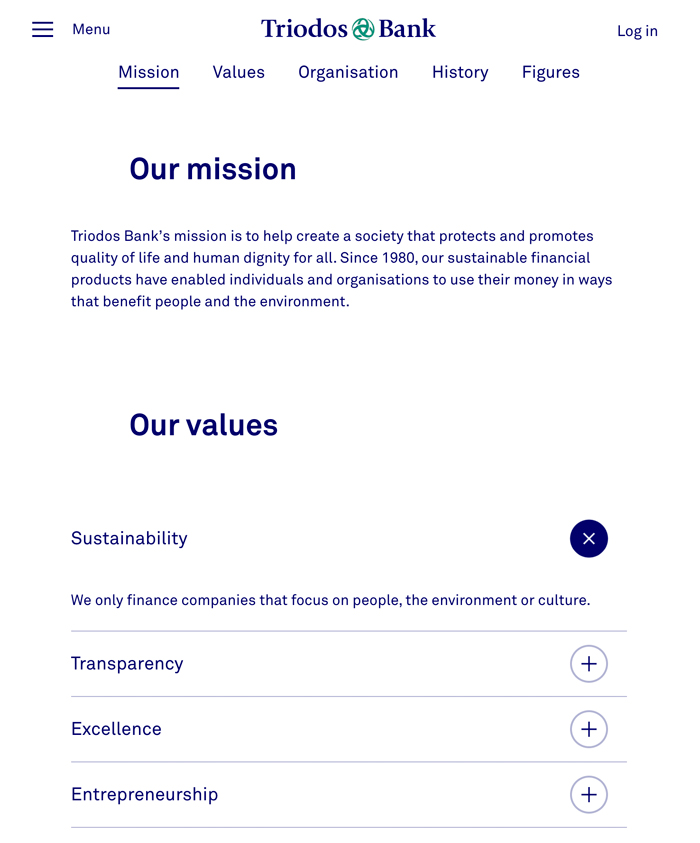
Image via © Triodos Bank
Triodos Bank is a good B2B example because it has a very clear value proposition centred around environmental sustainability — one of the world’s most sustainable banks.
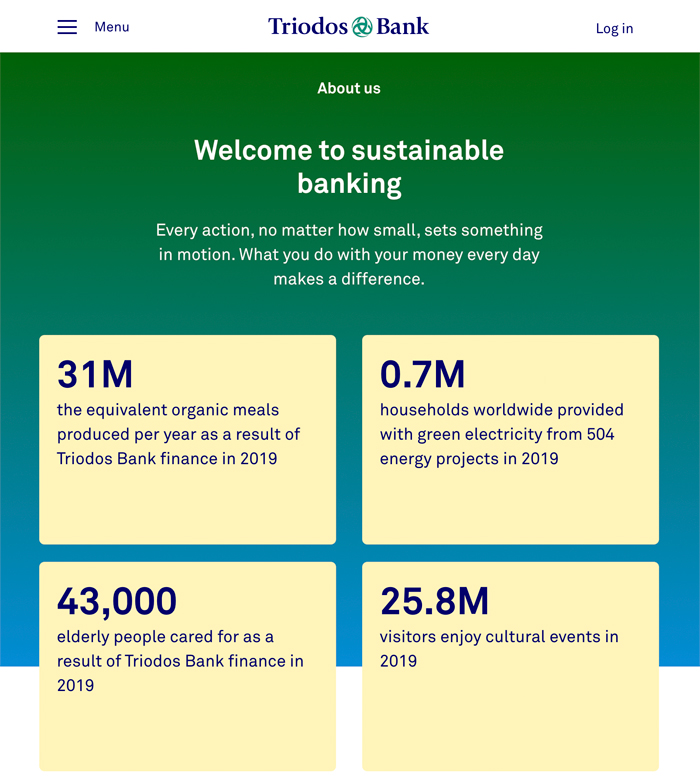
Image via © Triodos Bank
Truth be told, in the finance arena few banks really stand out with strong differentiation. The majority are dismal in spite of what they spend on trying to make themselves appealing. Triodos Bank, on the other hand states that because sustainability sits at their core they only finance companies that focus on people, the environment or culture. This value proposition then sits at the heart of all their communications and indeed, commercial decisions.
Related: How Branding Strategy is Different to Marketing
Why Leadership Clarity Strengthens Commercial Meaning
The strongest value propositions are rarely invented in isolation by brand strategy or marketing teams. They are clarified by leadership teams that have made disciplined choices about relevance, focus and strategic direction.
The strongest value propositions are rarely invented in isolation by brand strategists or marketing teams. They are clarified by leadership teams that have made disciplined choices about relevance, focus and strategic direction.
In practice, this is where many organisations begin to drift. A technology business may have a strong product but no longer be clear which problem it most wants to own. A professional services firm may keep adding capabilities until its value proposition becomes crowded and difficult to articulate. A premium consumer or luxury brand may broaden too far and dilute the very distinctiveness that once justified margin strength.
In each case, the commercial issue looks like messaging on the surface. But underneath it, the deeper issue is leadership clarity. What exactly is the organisation choosing to be known for? What is now central? What is peripheral? What is being defended because it still matters, and what is simply being retained because no one has clearly decided to stop?
That is why value proposition work is rarely just a communications exercise. It forces leadership teams to define what the organisation most wants to mean in the market — and what it is willing to leave behind in order to make that meaning stronger.
2. Crafting Your Value Proposition Forces Clarity on Other Key Elements of Your Brand Strategy
Some brands are born with an inherent value proposition. But many other brands need to dig deeper to uncover the hidden gems. In either case, it is far better for a brand to have a well-considered, well-articulated value proposition rather than simply fudging along thinking “it’s clear enough on its own”.
Even if it is clear enough to you as an engaged brand owner, it will often not be clear to target customers for whom your brand is only one of many they encounter over the course of each day.
One valuable benefit of taking time to purposefully craft your value proposition is that it forces careful consideration for all the other elements of your brand strategy, from your target market to your reasons to believe. In short, articulating your value proposition not only underpins your ability to achieve higher revenue, it also brings a lot more clarity around all the other elements within your brand strategy too.

Image via © Ilika
A B2B product case study is Ilika. Its value proposition is clearly focussed on solid state batteries for industrial and commercial uses. This makes its brand message crystal clear.
Related: Top 5 Ways to Build Profitable Brand Relevant Consumer Tech in a Storm of Massive Change
When Value Propositions Weaken from the Inside
Value propositions often weaken internally before they weaken externally.
The first signal is usually not market rejection. It is internal dilution. Different teams begin describing the organisation in different ways. New offers are added without re-evaluating what they do to the overall meaning. Sales teams start adapting the message case by case because the central proposition is no longer sharp enough to carry the weight on its own. Leadership continues to use the same language, but with less shared precision underneath it.
This pattern appears across sectors. In fintech, a business may start by being sharply defined around trust, speed or transparency, then lose clarity as it expands into adjacent services. In hospitality, a group may stretch across formats or customer types until the experience no longer expresses a single strong promise. In MedTech, a firm may have an innovative proposition but weaken its commercial articulation as product complexity grows faster than strategic focus.
I describe this as a leadership-to-market lag. Leadership still feels close enough to the business to believe the proposition is obvious. The market does not. Customers encounter only what is made visible through clarity, consistency and choice. If those weaken, the proposition starts to feel less distinct, even when the business itself still believes it is differentiated.
The commercial consequence is significant. Sales cycles lengthen. Teams spend more time explaining. Prospects compare on price because meaning is no longer strong enough to carry preference. The brand starts to lose pricing power not because the offer has no value, but because the value is no longer being led with enough clarity.
3. A Strong Value Proposition Improves Profitability
Effective branding is all about setting your offering apart from an undifferentiated competitive offering because that gives you the ability to attract your ideal customers. Most importantly, it gives you pricing power. The more relevantly differentiated your brand is, the stronger its pricing power and profit margin, relative to its peers. That enables a brand to achieve higher pricing and consequently higher profitability.
This varies by category. In luxury goods or high-tech medtech, for example, there may be more pricing elasticity than in lower engagement categories such as plastic pellets or fibre cables. But although the impact may vary, the principle holds: even in very low-engagement categories where pricing is the key driver for purchase decisions, a strong value proposition still underpins stronger profitability, albeit within bounds.

Image via © Henry Colbeck
A B2B product case study on this point is Henry Colbeck. This food service wholesaler focusses on supplying fish and chip shops. This simple but compelling value proposition allows it to build credibility with the trade. In turn this critical mass allows it to develop more bespoke offerings for the trade, which is a virtuous circle further entrenching the brand with its target audience.
Related: Profitable Lessons from Luxury Brand Leaders, Brand Positioning for Premium Pricing
4. A Strong Value Proposition Improves Your Sales Productivity
Effective marketing is supposed to generate awareness and drive demand, so the sales function can then convert it to highly profitable revenue. However, as many people have experienced first hand, the process doesn’t always work smoothly. In truth, depending on organisational culture and structure, it can be quite dysfunctional.
The fact is, with a weak or indistinct value proposition, it’s much harder for sales teams to open doors, let alone close the deal. When they do interact with potential buyers, they spend a lot of time and effort overcoming misunderstanding and explaining what sets their brand apart, when in practice very little does.
It’s like a person going for a job interview with nothing remarkable on their resume, while the next candidate offers relevant, unique skills to the hirer – it’s clear which one is more likely to get the job.
A well-constructed, relevant value proposition is not just a branding tool. It also underpins your leadership narrative as much as it does your sales script. Consequently, a strong value proposition improves your sales productivity, because the hard work of matching needs and wants to the brand is eliminated from the sales endeavour and delivered instead, with consistency, by the value proposition. The fact is, you could make a significant difference to your sales performance by starting with reevaluating your value proposition using a brand audit health check, so you can identify where and how to achieve higher revenue, build business resilience and mitigate risk.
A simple B2C product case study that illustrates this is Quattro window quadruple glazing. Customers intuitively understand that more glazing layers equals better insulation and weather protection. Quattro is the only brand whose value proposition answers this need, so sales professionals don’t need to spend much time explaining the benefit – it’s intuitive from the value proposition.
Related: The Impact of Company Brand Culture On Driving Performance and Increasing Sales
Value Proposition, Decision Ownership and Sales Coherence
Commercial clarity depends on ownership.
If no one clearly owns the value proposition, teams tend to personalise it, dilute it or keep adding to it. Marketing interprets it one way. Sales adapts it another. Product teams keep expanding what the brand appears to stand for. Leadership assumes alignment still exists because the language sounds familiar, even though the underlying interpretation is beginning to move in different directions.
This is where value proposition work becomes a decision ownership issue as much as a brand strategy issue.
Who has the authority to define what the organisation most wants to be chosen for? Who decides when an adjacent offer strengthens the proposition — and when it weakens it? Who has responsibility for protecting the distinction when short-term commercial pressure encourages the business to say yes to everything?
Without that clarity, the proposition becomes commercially expensive. Sales productivity drops because every conversation requires more explanation. Marketing loses efficiency because messages multiply. Customer confidence weakens because the organisation sounds different depending on who is speaking.
A well-led value proposition does the opposite. It reduces internal interpretation drift. It gives sales teams cleaner ground to stand on. It makes decision-making easier because not every opportunity now has to be evaluated from scratch. And it helps preserve the relationship between strategic meaning and commercial momentum.
5. A Unique Value Proposition Leads to Stronger Sales Conversions
Categories have inherent value propositions which are shared by all or most brands. For example, the broad value proposition of cloud hosting or refrigerated warehousing is the same across all vendors. That is why brands need to create their own value proposition, which makes them stand out to their target customers within their category, versus their competitors.
Often that will get the brand into a “consideration set” or it may create brand preference. But other factors could still mitigate against this. For example, the pricing premium might overstate the distinctiveness of the value proposition, or lack of availability may lead a customer to opt for convenience or speed of purchase over their preferred value proposition. That is why some companies intentionally work hard to generate a unique value proposition which leads to them being not just the preferred brand, but indeed the only brand for some customers.
This can take many forms such as;
- A unique ingredient
- Defining an industry standard
- Matching known tendering requirements in a way other brands do not
- Applying patented technology unavailable to other brands
- Developing a unique system that gets great results for your customers more cost-effectively — and consequently becomes a valuable piece of intellectual property in your business
These things do not happen by accident. Instead, in crafting its value proposition, the brand’s owner has considered what unique elements they can bring to the mix versus competitive brands.
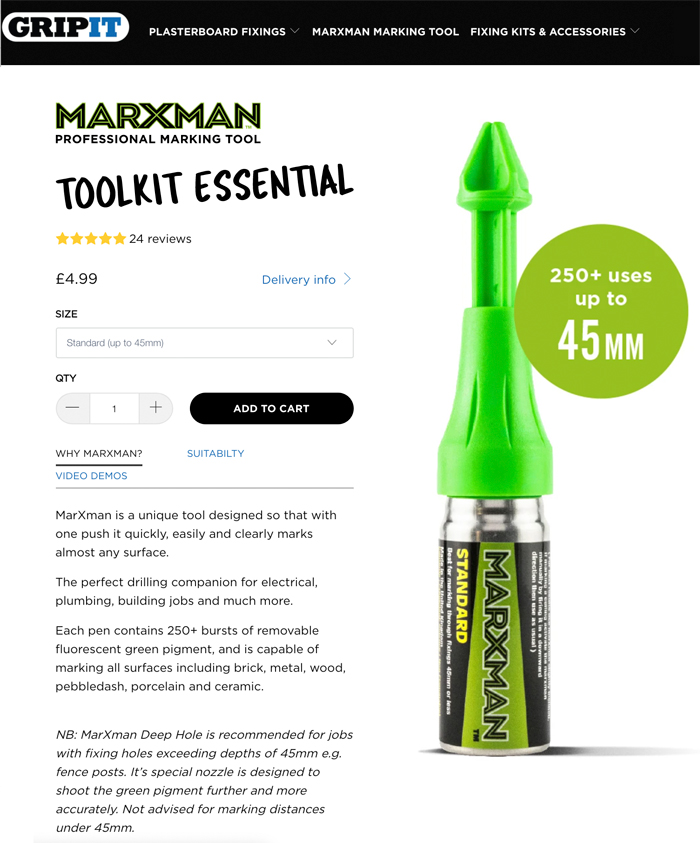
Image via © GripIt
A case study from the construction industry is Marxman. This builder’s marking utensil answers a clear user need, and with patented technology it is the sort of product that if specified in a service level agreement, for example, cannot be substituted.
Related: Leading in Adversity – 10 Practical Steps to Make Your Brand Work Harder to Grow Your Sales
6. A Clear Value Proposition Helps Sales and Marketing Converge Not Compete
One challenge in many companies is the potential conflict between marketing and sales. Marketing often neglects to develop a strong brand strategy with an irresistible value proposition and instead, focusses on brand elements such as features and benefits. Those may be used as a starting point by sales teams, but sales often also move away into their own territory, especially around pricing. This can effectively lose sales, but even when it wins sales it often does so at the expense of strong margins and resilient profitability.
A value proposition is an effective tool to mitigate those inherent vulnerabilities and challenges. A strong value proposition, driven from your brand strategy, sits across both your sales and marketing functions. If your value proposition is compelling, sales will see less need to go off-script in offering special deals, reduced pricing and various other commercially undermining efforts long term.
Related: Increase Sales Using Buyer Personas, Your Guide to Understanding and Targeting Your Ideal Customers
External Perspective: When Teams Need to Realign Quickly
Amy Edmondson’s TED talk on turning a group of strangers into a team is relevant because value proposition drift is often not a creativity problem. It is an alignment problem — especially when organisations are growing, restructuring or moving quickly.
A Practical Value Proposition Review Framework
If your value proposition feels less powerful than it should, the issue may not be creativity. It may be clarity.
A useful way to review it is to ask six practical questions.
- First, what do we most want to be chosen for now — not historically, but now?
- Second, where has our proposition become crowded, over-extended or too complicated to explain with confidence?
- Third, which parts of our current messaging are still genuinely backed by leadership decisions, behaviour and investment — and which parts are simply legacy language that remains because nobody has yet challenged it?
- Fourth, where are different teams describing the organisation differently, and what does that tell us about internal coherence?
- Fifth, what would a customer, stakeholder or buyer say we most clearly stand for today — and is that what leadership believes it is communicating?
- Finally, who now owns the decisions that protect the proposition, simplify it when necessary, and stop it from being diluted further?
These questions are practical because they move value proposition work out of abstraction and into leadership judgement, commercial discipline and owned strategic choice.
Three Reflection Questions for Leadership Teams
- Is the market experiencing a weaker value proposition because the proposition itself is wrong — or because leadership clarity around it has weakened?
- Where has our organisation added complexity, offers or messages that now dilute the meaning we most need to protect?
- Who currently owns the decision about what we most want this business to mean in the market — and is that ownership truly clear?
If your value proposition is becoming less distinct, the issue may be deeper than messaging. Consider exploring one or more of the following to strengthen commercial meaning from the inside out:
Final Thoughts
A strong value proposition differentiates your brand from your competitors and gives your customers a compelling non-priced based reason to buy, so you can achieve higher-margin sales.
Regardless of how obvious it may be to you, as the brand owner, if your primary target customers can’t see clearly what sets you apart from your competitors then you haven’t done enough — you probably don’t have a strong value proposition. In short, if they can’t instantly understand what makes your brand compelling on their terms you’re on a slippery slope to nowhere.
You also want customers and prospects to differentiate you for the right reasons. That helps you build your unique brand and helps you achieve long-term pricing power. A value proposition doesn’t need to be complicated, but it does need to be well-considered and realistic.
Even if you haven’t considered it before, you can start today to reassess your value proposition as it currently appears and where it potentially needs improvement, from your customers’ perspective, using a brand audit. Once you’ve established that essential baseline then you’ll be in a far stronger position to achieve higher revenue, build brand asset value and become a more resilient business longer term.
 “Having worked with Lorraine on a number of events and projects, I knew that taking part in the Persona Brand Leadership programme was going to open my eyes to how my brand could be mapped out and developed to help the business grow.
I had no idea just how much of an impact the programme would have in helping me to shape my whole business strategy and lay the foundations for my future plans. By evaluating my brand, defining and putting a structure on what we do and why it enabled me to map out the direction for where the business and brand are headed.
All the worksheets, tools, and resources you receive are very thorough and Lorraine gets a great sense of what your business is and what you are trying to achieve, so her guidance is tailored to you.
I would highly recommend working with Persona Design to any entrepreneur/SME that is striving for success.”
Fiona Kelly
Founder, Conference & Events Director
Zoom In & The Executive PA Forum
Questions to Consider
- How clearly defined is your value proposition currently?
- Does your brand strategy use your value proposition as an integral part?
- How does your value proposition drive your target profit margins?
- What does your value proposition offer which differentiates you from competitors?
- Does your sales process reflect your value proposition?
- Could you use a brand audit to help you work towards building a stronger value proposition, so you can identify where and how to achieve higher revenue, build business resilience and mitigate risk?

 © Lorraine Carter